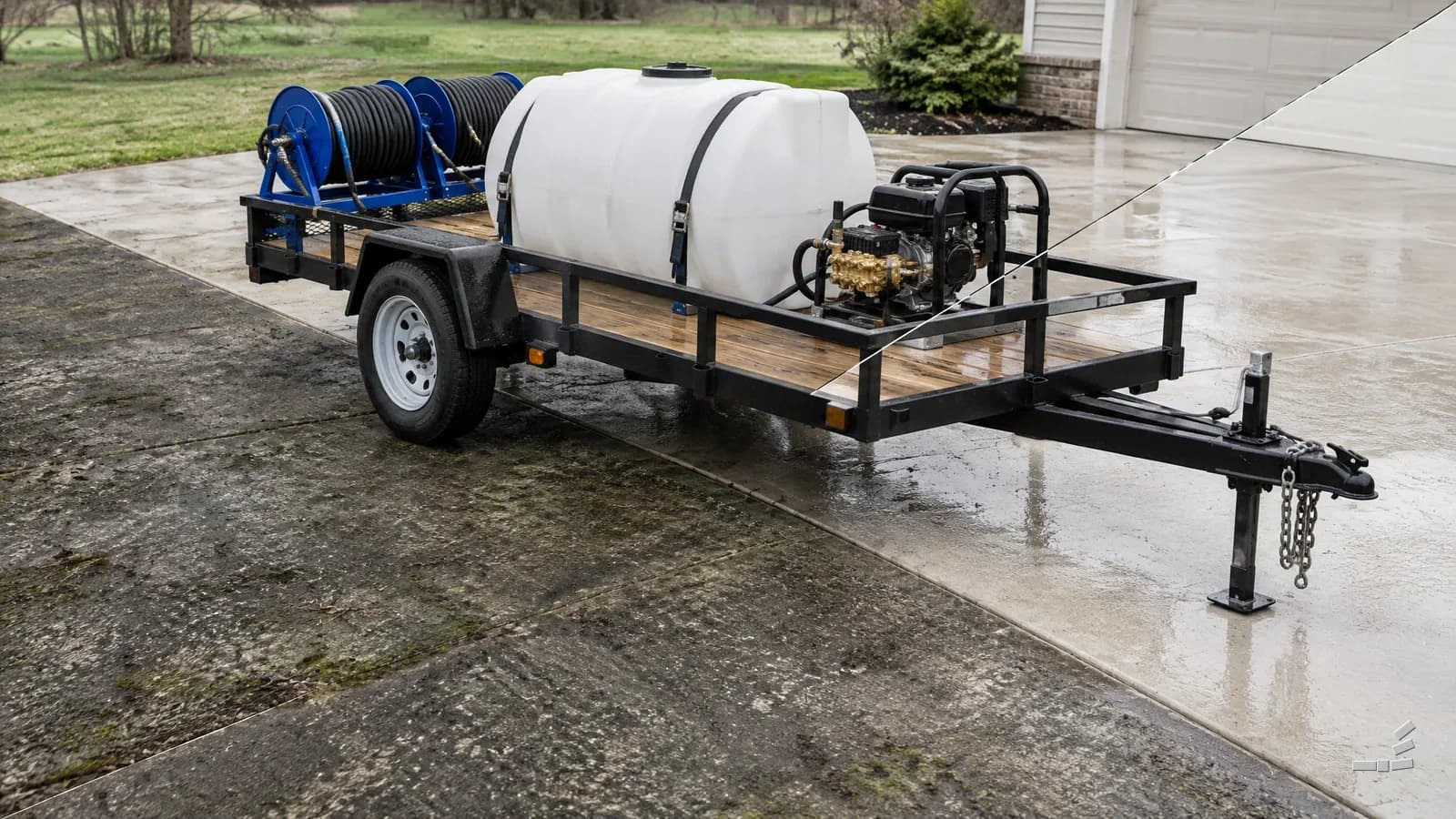
What a pressure washing trailer setup includes
10–15%
Of the loaded trailer’s weight should sit on the hitch (one vehicle maker’s guidance)
8.34 lb
What every gallon in the water tank weighs (USGS)
10,001 lb
The combined rating where a work rig crossing state lines becomes a commercial vehicle
A pressure washing trailer setup is five systems on one axle: a machine, a water tank that feeds it, hose reels, a chemical side, and the towing side that carries it all legally. Get the order right and the rig works on any driveway. Put the tank where it fits, plumb it with whatever hose was spare, and it will starve the pump, sway on the highway, or both.
Build it in this order: decide the water you must carry (the buffer tank size calculator works it out from your GPM and a bucket test), place the heavy parts around the axle, plumb the water side, add the chemical, then weigh the finished rig. The rest of this page takes those steps one at a time. If your soft wash runs from its own 12V pump, the pump and chemical tank are covered in soft wash system setup; this page is the trailer they ride on.
Pressure washing rig setup: where the tank, machine and reels go
Water is the heaviest thing on the trailer, and it is the only load that changes during the day. A full tank leaves the yard; an empty one comes home. Put the tank’s centre close to the axle and its weight splits between the hitch and the wheels in roughly the same proportion whether it is full or empty. Put it at the very front and a full tank loads the hitch hard; put it behind the axle and it lifts the hitch.
| Part | Where it usually goes | Why |
|---|---|---|
| Water tank | Centred just ahead of the axle | Biggest and changing weight; keeps the tongue load steady |
| Machine (skid) | Front of the deck, controls facing out | Fixed weight that adds tongue load; reachable to start and refuel |
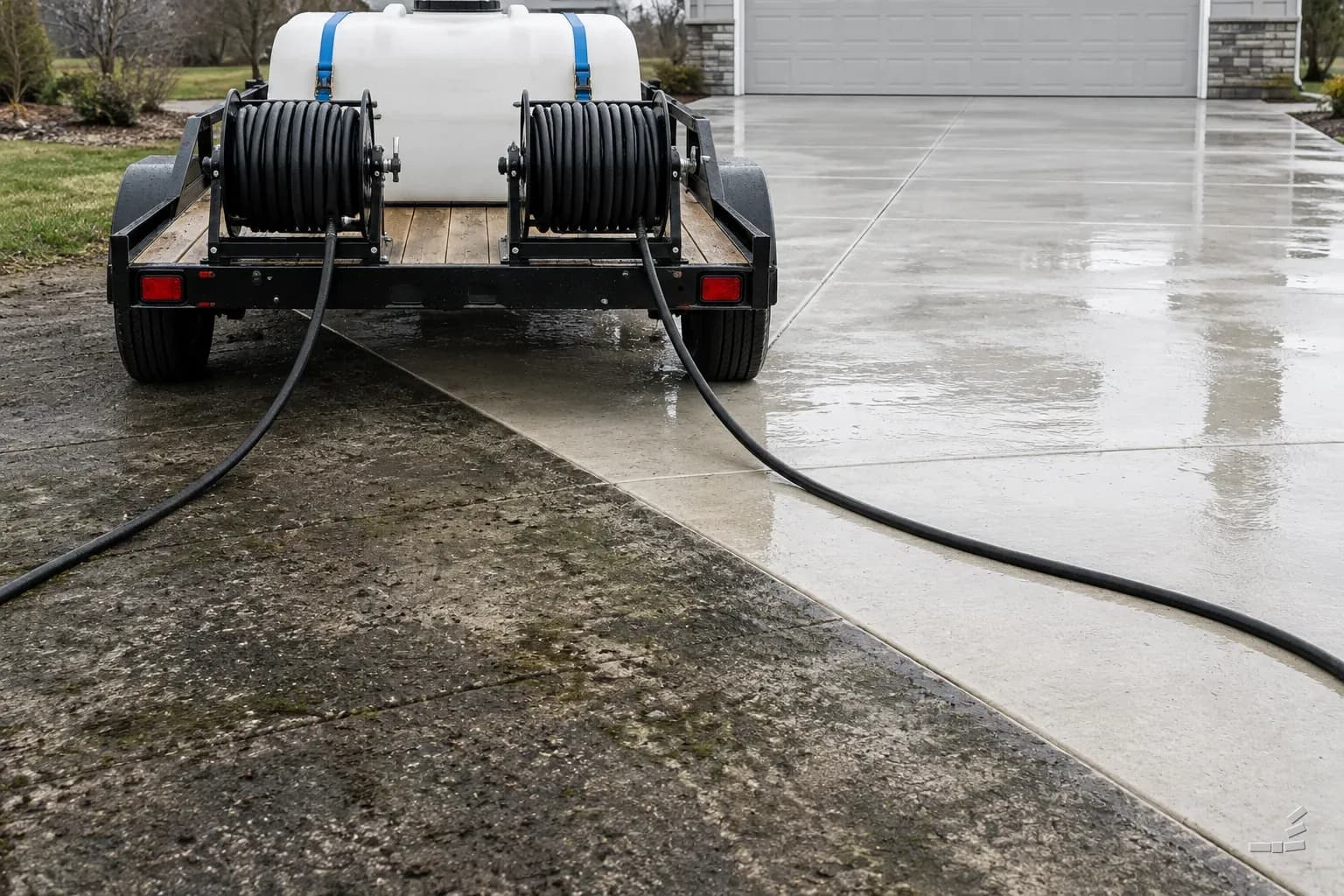
| Hose reels | Rear or curb side | Hose pulls toward the house, not across the road |
| Chemical tank | Its own corner, shaded, off the engine | Hypochlorite weakens with heat; keeps spills off the machine |
| Surface cleaner, ladders | Racks or lockable box, tied down | Loose gear shifts under braking |
Bolt the skid and tank to the frame, not just the deck boards, and strap anything that can slide. A partly full tank surges under braking, so ask the tank maker whether the tank you are buying is meant to ride on a moving vehicle. How chemical strength fades with heat is covered in the sodium hypochlorite guide.
Weight and tongue load
Every gallon in the tank weighs about 8.34 lb (USGS), so a tank of a few hundred gallons climbs past the weight of the trailer itself, as the example below shows. It uses example inputs; weigh your own rig.
| Line | Example input | Weight |
|---|---|---|
| Empty trailer | From its own scale ticket | 1,800 lb |
| Machine, reels, hose, empty tank, gear | Weighed on the trailer | 900 lb |
| Water | 300 gal × 8.34 lb/gal | 2,502 lb |
| Loaded trailer | Sum | 5,202 lb |
| Tongue load, tank full | 10–15% of 5,202 lb | 520–780 lb |
| Tongue load, tank empty | 10–15% of 2,700 lb | 270–405 lb |
That 10–15% band is Honda’s towing guidance for non-boat trailers. Your own tow vehicle’s manual gives its figure, and that is the one that binds you. Honda also explains why it matters: too much weight on the hitch takes traction and steering away from the front tires, and too little makes the trailer unstable and prone to sway. Check the band twice, with the tank full and with it empty, because the job empties it.
Three ratings, all at once
Plumbing the water side
The pump must never run short. Alkota, a machine maker, wants at least the machine’s GPM at the pump inlet, at a minimum of 20–30 PSI, and names a float tank as the way to even out a weak supply. A starved pump cavitates: it cannot fill its cylinders on each stroke, and the damage builds inside it.
- Tank above the pump. Pump maker Pumptec recommends a supply tank placed above the pump, so water arrives by gravity.
- A feed line that holds its shape. Pumptec typically recommends 1/2-inch S-hose to feed a pump inlet, because it holds its shape and lets enough water through. Match or exceed the inlet size in your pump manual.
- Strainer between tank and pump. A blocked strainer starves the pump just like an empty tank does. Put it where you can reach it.
- Bypass back to the tank. Pumptec says not to run the unloader’s bypass line straight back to the pump, because that can contribute to cavitation and overheating. Return it to the tank.
- High-pressure hose rated for the machine. Read the working pressure printed on the hose and on the reel swivel against the machine’s data plate.
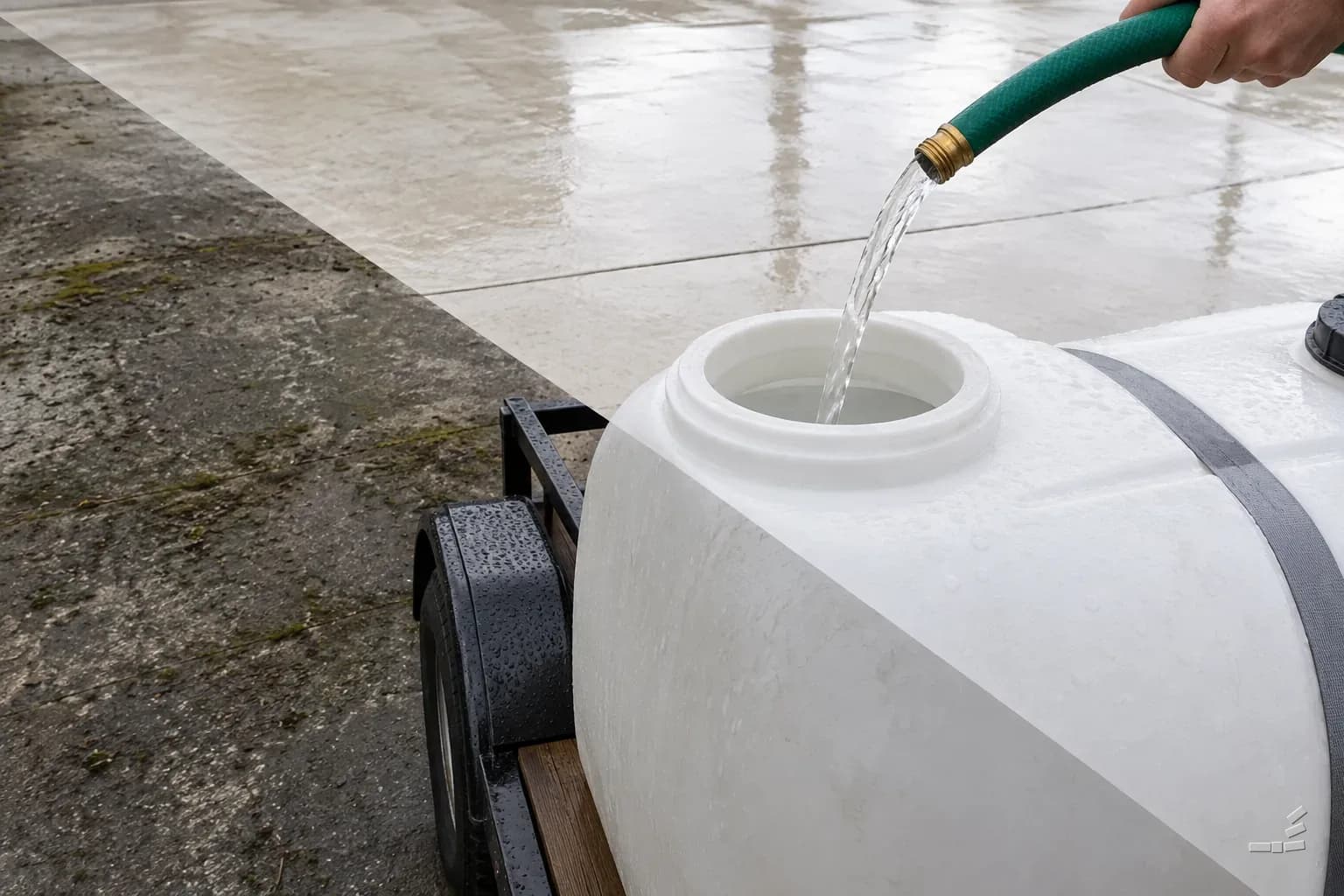
Fill through an air gap
The chemical side: injector or 12V rig
A trailer carries chemical one of two ways. A downstream injector draws it into the machine’s own flow, so it needs nothing on the trailer beyond a bucket or small tank. A dedicated 12V soft wash pump brings its own tank, battery and reel, and the soft wash system setup guide sizes all three. The trade-off between the two routes is set out in X-Jet vs downstream injector.
One chemistry per line
Open or enclosed trailer, or a skid in the truck bed
| Compared on | Open trailer | Enclosed trailer | Skid in the truck bed |
|---|---|---|---|
| Engine air and exhaust | In the open | Must be vented out of the box | In the open |
| Security and weather | Exposed; lock to the frame | Lockable, dry | Exposed |
| Water you can carry | Up to the trailer’s GVWR | Less: the box weighs too | Up to the truck’s payload |
| Parking at the job | Needs length | Needs length | One vehicle |
Carbon monoxide in a closed box
Hot-water machines add a burner and a fuel tank, which is why so many ride on a skid or trailer; see hot water vs cold water.
Rules for a commercial pressure washing trailer setup
Under federal rules, a truck and trailer with a combined rating of 10,001 lb or more is a commercial motor vehicle when it is used in interstate commerce. The rule counts the rating or the actual weight, whichever is greater, and a combined rating can be the truck’s and trailer’s GVWRs added together. A truck rated 9,000 lb towing a trailer rated 7,000 lb is 16,000 lb combined, well past it.
| What applies | In short | Rule |
|---|---|---|
| USDOT number | Register with FMCSA on Form MCSA-1; private carriers included | 49 CFR 390.201 |
| Medical certificate | The driver carries a current medical examiner’s certificate | 49 CFR 391.41 |
| Fire extinguisher | On the truck: one rated 5 B:C, or two rated 4 B:C | 49 CFR 393.95 |
| Trailer brakes | Brakes on every wheel; a trailer of 3,000 lb or less is exempt only while its axle weight stays at or under 40% of the truck’s | 49 CFR 393.42 |
| Breakaway brakes | A trailer that must have brakes applies them by itself if it breaks away, and holds them at least 15 minutes | 49 CFR 393.43 |
| Load secured | Cargo contained or tied so it cannot shift and upset the vehicle | 49 CFR 393.100 |
| CDL Group A | Combined rating 26,001 lb or more and a trailer rated over 10,000 lb | 49 CFR 383.91 |
The CDL rule applies whether or not you cross a state line. For the rest, work that stays inside one state falls under that state’s own rules, and every state also sets its own trailer brake, breakaway and registration rules. Ask your state DOT before the rig is built, not after. The truck and trailer used for work also need the right insurance; the commercial auto line is explained in pressure washing insurance.
PSI & nozzle quick reference
- 0 degRed
- Spot jet. Etches most surfaces.4000 PSI
- 15 degYellow
- Stripping bare concrete.4000 PSI
- 25 degGreen
- General concrete and walkways.3500 PSI
- 40 degWhite
- Siding, wood, vehicles.1500 PSI
- ~65 degBlack
- Detergent draw, low pressure.500 PSI
A DIY or homemade pressure washer trailer setup checklist
- Size the water from your GPM and a bucket test, then work out what it weighs.
- Pick a trailer whose GVWR carries the loaded total with margin, and a truck rated to tow it.
- Mount the tank’s centre just ahead of the axle, the machine forward, the reels at the back.
- Plumb tank above pump, strainer, sized feed hose, bypass back to the tank.
- Give acid and hypochlorite separate containers, pumps and hoses.
- Bolt and strap everything, then weigh it full and empty at a public scale.
- Check the federal and state rules for the combined rating before the first paid job.
The day-of version lives in the pressure washing job checklist, and the rest of the starter kit is in how to start a pressure washing business.
Do I need a CDL to tow a pressure washing trailer?
Under 49 CFR 383.91, a combination needs a Group A CDL when its combined rating is 26,001 lb or more and the trailer’s own GVWR is over 10,000 lb. Read both numbers off the labels. Your state issues the licence and can add its own classes, so check with it too.
Should the water tank sit over the axle?
Its centre should sit close to it, slightly ahead. The tank is the load that changes during the day, so keeping it near the axle keeps the share of weight on the hitch close to the same whether it is full or empty. Weigh it both ways and check both against the 10–15% band.
Can I run the machine inside an enclosed trailer?
A joint alert from NIOSH, OSHA, CPSC, EPA and Colorado’s health department, which names high-pressure washers among the equipment, warns that small gasoline engines in enclosed or partly enclosed spaces can build up deadly carbon monoxide even where the space looks well ventilated. Follow the machine maker’s instructions for venting its exhaust out of the box, and never work inside the trailer while the engine runs.
How big a water tank does the trailer need?
It depends on your machine’s GPM and how much the spigot gives. The buffer tank size calculator sizes it from a bucket test and shows what the water weighs.