Belt drive vs direct drive pressure washer
Updated 2026-10-31
- Best for daily work
- Belt driveThe pulleys turn the pump at half the engine's speed or less, and the belt keeps engine heat, vibration and start-up shock off it. That is where the extra money goes.
- Best for part-time use
- Direct driveFewer parts, no belts to tension, a smaller frame and a lower price. For a few hours a week the faster pump is a fair trade.
- Best for a compact build
- Gearbox direct driveIt bolts to the engine like a direct drive, but the gearbox runs the pump at half the engine's speed, per Cat Pumps.
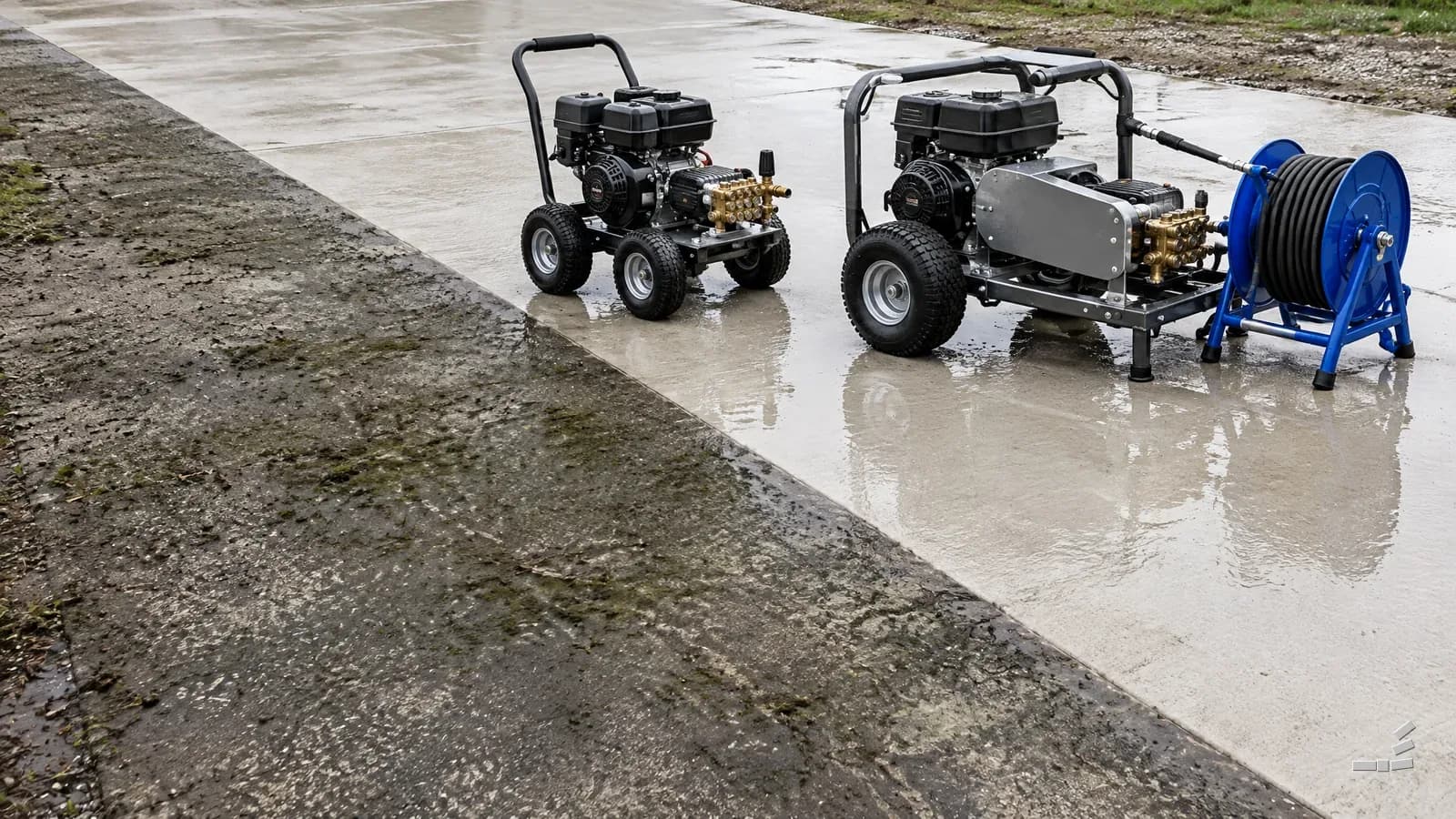
The difference in one table
Both machines put a pump on an engine. What changes is the joint between them. On a direct drive the pump sits on the engine shaft and turns at engine speed. On a belt drive the pump has its own shaft and frame, and pulleys set how fast it turns.
| Spec | Belt drive | Direct drive |
|---|---|---|
| How the pump is driven | Pulley on a solid pump shaft, belts from an engine pulley | Hollow pump shaft slid onto the engine shaft, flange bolted to the engine |
| Pump speed | Set by the pulleys, typically 900-1,740 RPM | Engine speed, about 3,450 RPM on gas |
| Engine heat reaching the pump | Kept apart by the belt | Passes both ways through the mount |
| Vibration and start-up shock | Taken up by the belt | Go straight into the pump |
| Priming from a tank | Easier at the lower RPM | Harder at the higher RPM |
| Changing the flow | Swap a pulley | Fixed by the engine speed |
| Parts to look after | Belts, pulleys, tension, guard, pump oil | Pump oil; the shaft key is a wear point |
| Size and weight | Bigger frame, more steel | Compact |
| Upfront cost | Higher | Lower |
| Best for | A machine that runs most working days | Part-time work and homeowners |
Speeds are the makers’ own: BE Power Equipment gives about 3,450 RPM for a gas engine and 900-1,740 RPM for a belt-driven pump. The other rows sum up what BE, Alkota and Cat Pumps say. All read 31 October 2026.
Same pump family, two speeds
The clearest way to see the difference is one maker’s pump sold both ways. The pump makers rate each version for the speed its drive gives it:
| Maker | Pump | Drive | Rated RPM |
|---|---|---|---|
| Cat Pumps | 56 (solid shaft) | Belt | 1,210-1,760 |
| Cat Pumps | 56G1 (gas flange) | Direct | 3,600 |
| General Pump | T / TS Series 47 (24 mm solid shaft) | Belt | 1,050-1,845 |
| General Pump | EZ gas (1 in hollow shaft) | Direct | 3,400 |
From the makers’ own pump listings, read 31 October 2026. Solid-shaft pumps are the belt-drive kind; hollow-shaft and flanged pumps mount straight to the engine.
How the pump is driven
Direct drive
A direct-drive pump has a hollow shaft. It slides over the engine’s crankshaft, and its flange bolts to the face of the engine. Nothing sits between the two, so the pump turns at whatever speed the engine runs. BE Power Equipment puts a normal gas engine at about 3,450 RPM. On an electric machine the pump follows the motor: Cat Pumps lists its electric direct-drive pumps at 1,725-1,750 RPM or 3,450 RPM, the two common motor speeds.
That layout is why direct drive is the cheaper, smaller machine. There are fewer parts, nothing to tension and no second frame for the pump to sit on. Alkota and BE both list lower cost, a compact frame and very little upkeep as its strengths.
Where it falls short: the pump lives next to a hot engine and spins at engine speed all day. Alkota notes that heat passes between engine and pump, that a high-RPM pump is harder to prime, and that the shaft key and keyway are a wear point that is more expensive to fix. It is also the louder of the two at full throttle.
Belt drive
A belt-drive pump has a solid shaft with its own pulley, and one or more belts run to a smaller pulley on the engine. The pump and engine bolt to a shared frame, side by side. The pulley sizes set the ratio, which is how the pump turns at half the engine’s speed or less: BE gives a typical 900-1,740 RPM.
The belt does three jobs besides slowing the pump. Cat Pumps says it isolates the pump from the engine’s heat and vibration, and from the shock of the engine starting, which wears the crankshaft and drive end. BE adds that a belt-drive pump carries a bigger crankcase of oil, so with the lower RPM it runs much cooler. BE also lists a longer lifetime among its benefits.
It is also the easier pump to feed. Alkota says a lower-RPM pump primes more easily, which matters when the machine draws from a buffer tank rather than a hose bib, as on most trailer setups. And because flow follows pump speed, Cat Pumps points out you can change a belt machine’s flow with a different pulley.
Where it falls short: it costs more, weighs more and takes more room on a truck or trailer. There are more parts to watch, and a snapped belt ends the day unless a spare is in the truck.
What each one asks of you
Both pumps want the same oil care. Cat Pumps says to change the crankcase oil after the first 50 hours, then every 500 hours. Oil that turns milky means water is getting past worn seals, and that can damage the drive end if you keep running.
- Belt drive adds the belts. Check tension and look for cracks or a glazed face at every oil change, keep the pulleys in line, and carry a spare set. A slipping belt shows up as pressure that sags under load.
- Direct drive adds nothing to tension, but its pump takes the heat. Do not let it sit in bypass with the trigger closed for long. The water trapped in the pump heats up fast with no flow through it.
Keep the belt guard on
The gearbox option and the pulley arithmetic
There is a third layout between the two. Cat Pumps sells gearbox pumps that bolt to the engine like a direct drive, but the gearbox lets the pump run at half the engine’s speed. You get the slower pump without a belt or a second frame. It is still a fixed ratio, so you cannot change the flow with a pulley swap.
The pulley arithmetic is simple: pump RPM = engine RPM × engine pulley ÷ pump pulley. A 3,450 RPM engine with a 3.5 in pulley driving a 7 in pump pulley turns the pump at about 1,725 RPM. Whatever the ratio, never turn a pump faster than its maker’s rated RPM.
Pick the drive by the rig
The drive type does not change how much a machine cleans per pass; the PSI and GPM do, and the cleaning units calculator compares two machines on that. Pick the flow first, then the drive by how many hours the machine will run and where it lives.
| Your rig | Drive | Why |
|---|---|---|
| Homeowner, own driveway and siding | Direct drive | A few hours a season. The cheaper, lighter machine cleans the same at the same PSI and GPM. |
| Part-time crew, weekends and evenings | Direct drive | Low hours keep the faster pump's wear in check, and the compact frame fits a pickup bed. |
| Full-time flatwork rig | Belt drive | Most working days at 4 GPM behind a 20 in surface cleaner is the load the slower, cooler pump is built for. |
| Trailer rig fed from a buffer tank | Belt drive | The lower-RPM pump primes more easily from a tank, per Alkota, and the trailer has room for the frame. |
| Tight skid or truck bed, daily use | Gearbox direct drive | Half the engine's speed at the pump in a direct-drive footprint, per Cat Pumps. |
Whichever drive you choose, read the pump’s rated RPM on its maker’s sheet rather than the engine badge: it tells you which drive the pump was built for. The gas vs electric compare covers the step before this one, and the start-up guide lists the rest of the kit that goes with the machine.
Common questions
Is a belt driven pressure washer better than direct drive?
For daily work, yes. The belt slows the pump to half the engine's speed or less and keeps engine heat, vibration and start-up shock off it, which is why makers like BE list a longer lifetime for it. For occasional use the direct drive is the better buy: cheaper, lighter, smaller and with fewer parts.
Does a belt drive pressure washer give more PSI?
Not by itself. A machine's pressure and flow come from the pump's rating, the nozzle and the unloader. Two machines with the same PSI and GPM clean the same; the drive changes how hard the pump works to get there.
Can you convert a direct drive pressure washer to belt drive?
Rarely worth it. A direct-drive pump has a hollow shaft made to slide onto the engine, while a belt drive needs a solid-shaft pump, two pulleys, belts, a guard and a frame that holds the engine and pump side by side. Price those parts before you start.
Why is a belt drive power washer more expensive?
More parts and more steel: a second shaft and bearings for the pump, the pulleys, the belts and their guard, and a frame big enough to hold the engine and pump side by side. Alkota and BE both list a higher upfront cost for it.
What RPM does a direct drive pressure washer pump run at?
The engine's speed, because it sits on the engine shaft. BE Power Equipment gives about 3,450 RPM for a gas engine, and Cat Pumps and General Pump list their gas direct-drive pumps at about 3,250 to 3,600 RPM.